umma.dev

The Patent Behind the BIC Pen

The BIC Cristal is the best-selling pen in history. One hundred billion sold by 2006, moving at roughly 57 units per second globally. Its design has been in New York’s Museum of Modern Art since the 1970s. It’s entire existence traces back to a single patent filed in Buenos Aires in 1943 by a Hungarian journalist who was annoyed by fountain pens.

The Original Patent

β€œWriting Instrument” (US2390636A) Laszlo Biro and Georg Biro, filed June 17, 1943, granted December 11, 1945
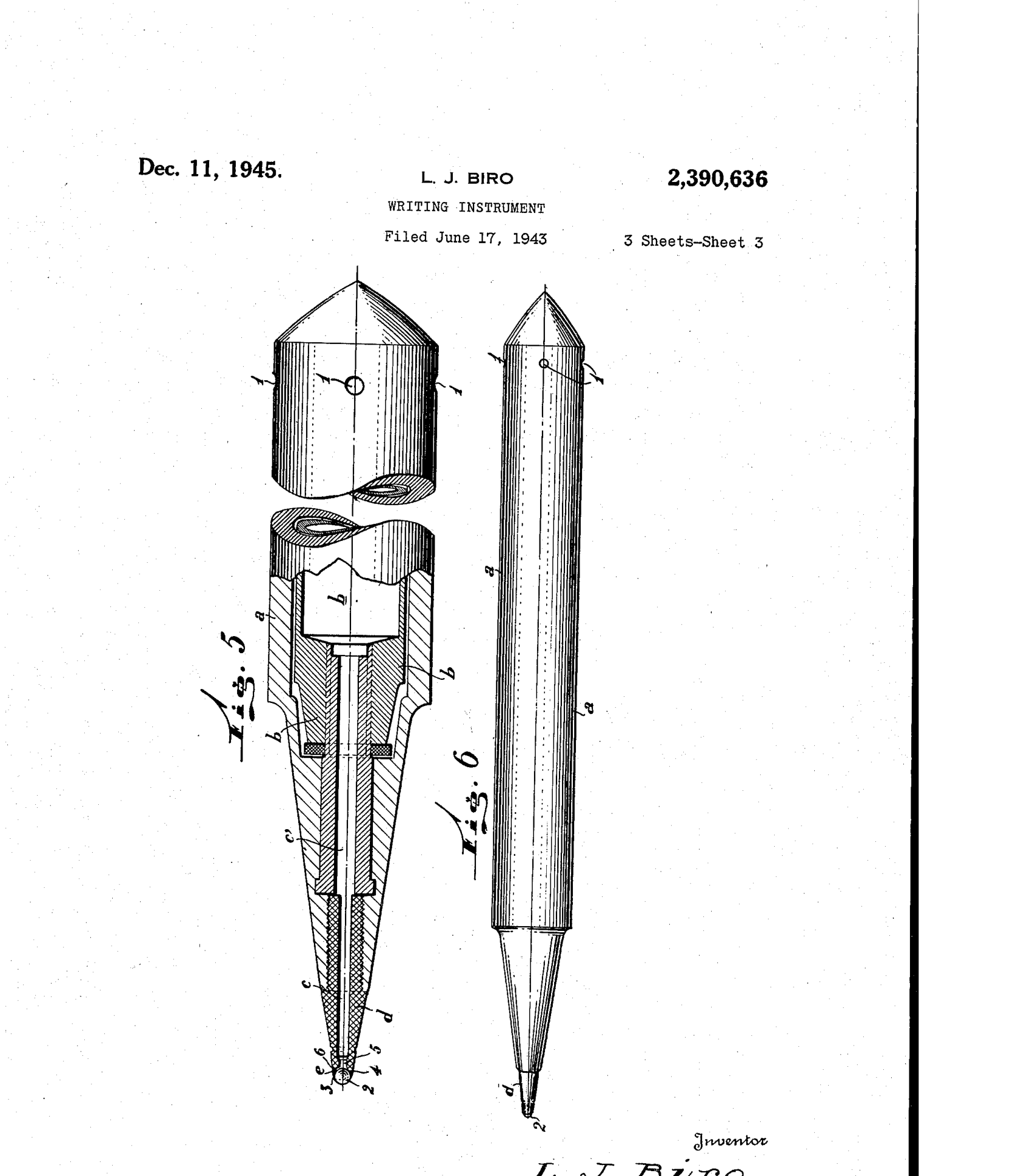
US2390636A patent drawing showing the ball-bearing tip mechanism: top view of the ball socket with feed channels radiating outward, and cross-section showing the ball seated in its conical housing

Laszlo Biro worked as a newspaper editor and noticed newsprint ink dried almost instantly, while fountain pen ink smeared and required frequent refilling. Fountain pens were open to the atmosphere, which meant constant evaporation. The ink was thin by necessity as thick ink would not flow through a nib and thin ink dried slowly on paper.

Biro's solution, developed with his brother Georg (a chemist), was to replace the nib with a tiny rotating ball bearing seated in a socket at the tip of the pen. The ball touches both the ink reservoir and the paper simultaneously. As it rolls across the page, it picks up a thin coating of ink from the reservoir and deposits it on the writing surface. The ink reservoir could now use a viscous, paste-like formulation that would not flow freely on its own. This means it would not leak or evaporate and would dry quickly on contact on paper.

Fig. 1 (the circular diagram) shows the tip from above. The ball sitting in its socket, surrounded by the bearing points and feed channels that deliver ink from the reservoir. Fig. 2 shows the cross-section - the conical housing that grips the ball while allowing it to rotate freely in any direction. The patent's central claim is this combination of ball-and-socket tip with thick ink.

The Biro brothers had fled Hungary in 1938, moved through Paris. and eventually settled in Argentina in 1943 (which is where the patent was filed). Argentina later named September 29 as Biro's birthday and is also known as National Inventors' Day.

From Patent to Product

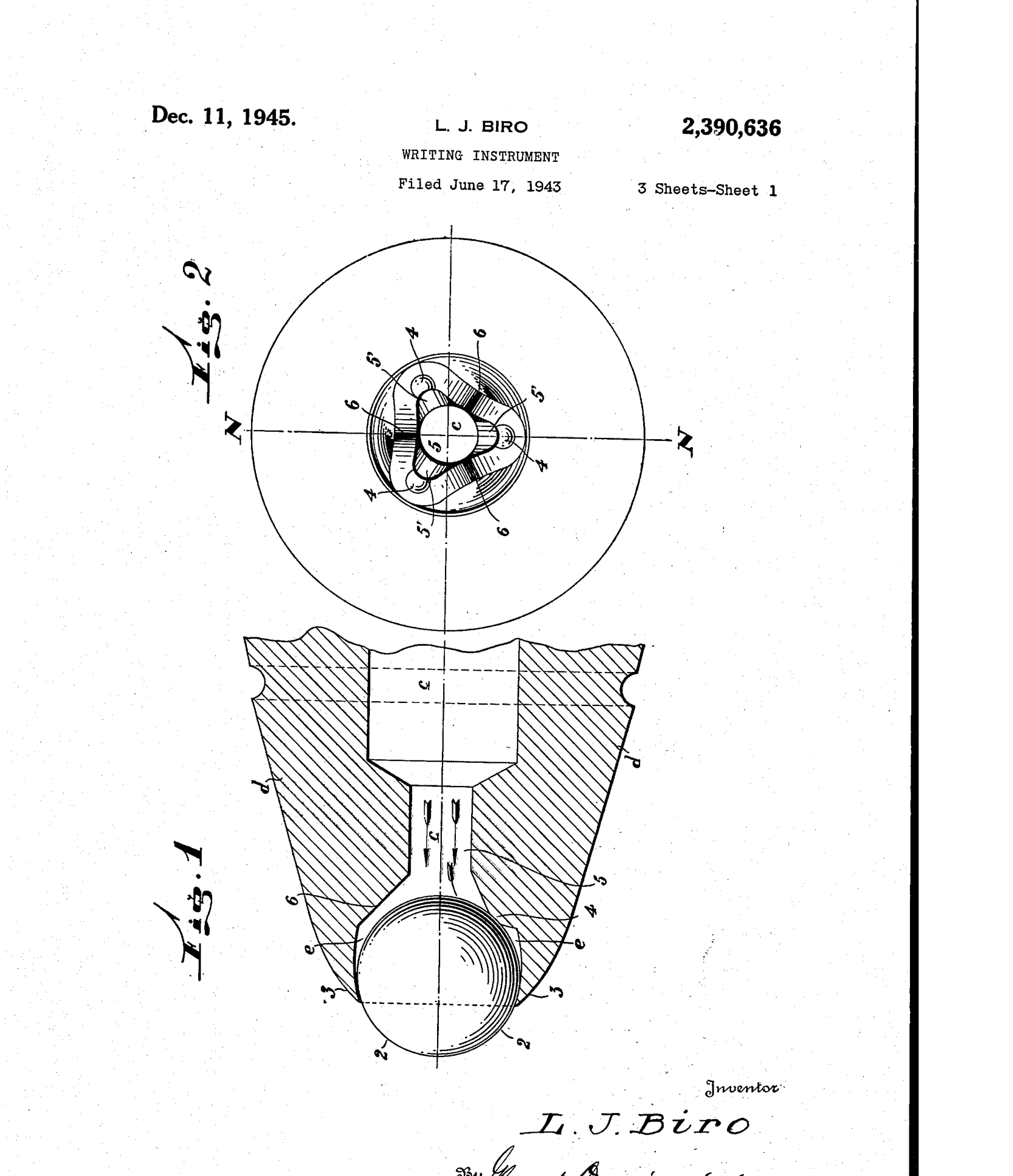
US2390636A patent drawing showing the full pen assembly: exploded view of the tip with its ink channels and ball socket, alongside a complete assembled pen in side view

Marcel Bich was a French entrepreneur who saw the Biro patent and understood something the inventors had not fully capitalised on; the design was manufacturable at industrial scale. He licensed the technology in 1944, dropped the "h" from his surname to create a brand name that would read cleanly across European languages and in 1945 co-founded Societe Bic with Edouard Buffard in Clichy, near Paris.

Fig. 5 (the exploded view) and Fig. 6 (the assembled pen) show the full instrument as Biro envisioned it. A cylindrical reservoir body that separates from the tip, with the ball mechanism at the point. What the drawing does not capture is how much precision the manufacturing required. Bich invested in Swiss machining capable of shaping metal to 0.01 millimetre tolerances. The stainless steel ball in the original BIC Cristal was replaced with tungsten carbide in 1961, ground to 0.1 micrometre accuracy - a sphere precise enough to rotate freely without wobbling, which is what determines whether a ballpoint pen writes smoothly or skips.

The five years between 1945 and the December 1950 launch of the BIC Cristal were engineering years. Bich developed a new ink formulation, more viscous than what Biro had used, which reduced bleed-through on ordinary paper. The barrel is transparent polystyrene, you can see exactly how much ink remains. The hexagonal cross-section stops the pen rolling off a desk. The cap has had a small hole since 1991, added after children choked on caps that had been swallowed. None of these are accidents; each one is a deliberate engineering decision solving a specific problem.

BIC entered the American market in 1959 at 29 cents, advertising with the line "writes first time, every time." In 1965, the French Ministry of Education approved the Cristal for classroom use. The pen has remained almost unchanged since.

What the Patent Actually Did

Biro’s US2390636A is a mechanical patent describing a physical configuration; ball in socket, viscous ink, air intake to replace consumed ink in the reservoir. The claims are tight enough to protect the specific mechanism while leaving room for competitors to develop their own ball-and-socket implementations using different geometries.

The original Biro pen worked but cost several dollars at a time when fountain pens cost comparable amounts. BIC brought the price below a dollar, then below fifty cents, then to a point where the pen became disposable. Once a writing instrument is cheap enough to lose without regret, it becomes ubiquitous. That transition - from licensed patent to commodity object - is what turned a 1943 filing in Buenos Aires into 100 billion units sold.