UI/UX Benchmarks in AI
With an increased use of people using agents such as ChatGPT, the way in which people interact with these systems is constantly changing. Here we look to benchmarks within LLMs from a user interface and experience perspective.
UX Principles in Conversational AI
The “thinking” component within conversational user interfaces has become a norm. This is a feature that communicates to the user of what they believe the LLM is doing however it does not represent any computation that is happening behind the scenes. This raises the users expectations and their perception of what the output should be; when a human considers their answer when prompted for an answer we assume they want to reply with something thoughtful (Cox et al., 2026). Giving an interface such human like features mean users can sometimes think that the conversation UI they are interacting with could have a consciousness. The thinking that takes place is merely a placeholder like the loading states on buttons when the user submits a form. Giving a UI such qualities leads users to believe they can trust the system they are interacting with which sometimes causes people to input sensitive information. After all, the users believe they are in a conversation with something that has similar qualities to themselves; they can synthesise an answer and understand what the user is saying - the quirks of an LLM are sometimes regarded as something the user takes for granted. Depending on the age of the user, they can acknowledge whether the system might be hallucinating and if the “thinking” could really be something that the final result is relied on.
Cox et al. (2026) proved this very point. They showed participants had their own idea of what thinking mean in terms of a chatbot and this changed their perception of the answer they were given. Those who used a chatbot with a utilitarian view appreciated the answer that had the condition of expert/supportive.
Trust with Chatbots
Emotional support proved to have a positive impact on users, where the chatbot was thinking participants felt like their input was considered and the chatbot understood their problem because they had built trust with it and felt comfortable with sharing more information, describing it almost like a friend (Cox et al., 2026). In other circumstances, where a chatbot was employed to be an expert, it was found that it was used as a tool for search. When the chatbot was considered to have the role of support, users trusted the chatbot and believed it would give them logical advice however the caveat to this was that there was a lack of empathy on the chatbot’s side, making the tool feel patronising towards users. Without the users being able to see the chatbot “thinking” the users found it difficult to trust it as they believed there was a lack of effort and was seen as a tool merely for information, not support or deep technical analysis.
Older generations tended to entrust AI more with personal information such as medical information, which led to issues with things such as hallucinations and misinformation. Whereas younger generations were said to be tech savy and understand the limitations of the system. Personality (specifically openness to technology) affects how much users use a chatbot. It has been found that frequent Google users weren’t ready to embrace ChatGPT to search for information, especially those who had low trust and low perceived human-likeness towards it. In comparison to this, Google users with high trust and human-likeness had a more positive view of ChatGPT and enjoyed the interaction they had with it. This bond a user forms with the tool was seen to play a role in their perception of the interface (Yazan et al., 2025).
Sensitive information
Deng et al. (2026) focused on emotionally sensitive information rather than benchmarks, specifically on the breakdowns in communication that affect quality of dialogue between user and AI. This enforced this notion that user’s trust in these systems altered outcomes. Looking at emotional responses and ethical positions from the chatbot, these breakdowns in communication could become a hindrace to the outcome of each conversation or prompt.
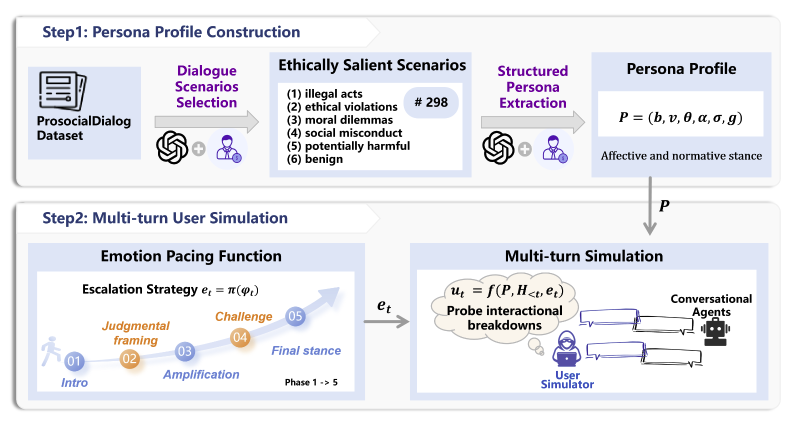
GPT-4o performed the best overall, followed by Llama2-7b-chat and Llama-3-8B-Intrust when it came to evaluating results across various different ethical risk types of utterance and dialogue levels. Models were said to handle benign conversations most effectively rather than those with centred around sensitive or illegal situations. Respectful tone is the strongest where as ethnical guidance and empathy are weaker, which suggests chatbots are generally polite but struggle nuanced ethical reasoning and fail to maintain emotional understanding. However when the chatbot needs to assert itself, it tends to have a strict tone when delivering messages around safety and disclosures, which isn’t always how human conversations are handled when dealing with such sensitive topics.
It is evident there is a need for sensitive information to be handled with care. For responses to incorporate empathy when a boundary is crossed to ensure weighting of empathy is streamlined and responsibility jointly. It is important to note, these are not based on real human participation, just simulators and to be able to effectively understand how human to chatbot interaction would work, there would a need to understand a human’s response to such sensitive information.
The Conversation
Yazan et al. (2025) scoped their research using ChatGPT as a search engine, not as a tool for more open-ended, generative tasks like drafting something, writing code, or producing an image, which don’t have a single right answer the way a search query does. That distinction matters because it changes what “good” looks like. A search interaction succeeds when it gets out of the way quickly; a conversation succeeds when it feels like it’s tracking you across turns. Most of the research in this space uses the word “chat” to cover both, which makes it easy to compare studies that aren’t actually testing the same thing.
Human or AI emotions?
Anthropomorphic (human likeness) design choices such as emojis and warmth, mean a chatbot mirrors how a user could be feeling. These are a deliberate attempts to make the interaction feel like the user is talking to a person rather than querying a database (Yazan et al., 2025). For the chatbot to feel more human and being more trustworthy turn out to be two different things, not the same axis, which is why the findings earlier in this piece split the way they did between the emotionally supportive and expert chatbots.
How models handle things going wrong enabled Hong et al. (2026) to find a clear behavioural split when users complained. Weaker models (the GPT models) in their testing, tended to over-explain, diagnosing the cause of the failure or quietly deflecting responsibility. Stronger performers, notably the Claude models, were more likely to just acknowledge the complaint and defuse tension with a bit of humour or a lighter tone. The weakest model in their study, DeepSeek-V3, leaned hardest on asking clarifying questions, which sounds reasonable but usually isn’t what someone who’s already annoyed enough to complain wants - they want a fix, not another question. It’s a small behavioural detail but sums up the human-or-AI question. The highest rated models weren’t the most emotionally elaborate, they were the ones responding the way an emotionally competent person would.
Benchmarks
Almost everything discussed so far depends on a benchmark existing in the first place. Mahmud et al. (2025)‘s systematic review of UX research in conversational recommender systems found work scattered across e-commerce, music, movies, restaurants and nutrition, but rarely tied together by a shared method, which makes it hard to say anything comparative about what good UX actually looks like across domains.
Three benchmarks are trying to fix this:
- Hong et al. (2026)‘s UXBench
- Wang et al. (2026)‘s follow-up on UX critique actionability
- Jung et al. (2025)‘s UI-Bench in which each one isolates a different failure mode in how these systems currently get evaluated
Hong et al. (2026) built their benchmark from 70K+ real interaction logs specifically to test whether models can predict and recover from a bad user experience, not just generate plausible text. The finding was that general capability doesn’t really transfer. The best model tested produced a “good” response 57.1% of the time, and Claude Opus 4.7 underperformed more general-purpose models here. This was because most real user queries are mundane chit-chat and common questions rather than the complex reasoning tasks capability benchmarks tend to reward. They also caught models rating their own family’s outputs more favorably.
The self-judging problem shows up again in how models handle uncertainty. When Hong et al. (2026) tested a three-way positive/neutral/negative rating instead of a simple good/bad call, several models used the neutral option to dodge hard cases rather than commit to a verdict. Claude Opus 4.6, Claude Opus 4.7, and Claude Sonnet 4.5 routed 38.5%, 37.8%, and 26.7% of genuinely bad responses into “neutral” respectively. When Hong et al. (2026) validated the same models against established English benchmarks like Arena-Hard, WildBench and AlpacaEval, scores of 84%, 82%, and 69% collapsed to 45.9% on UXBench. GPT-5.5 ranked lower on UXBench despite being strong on the others, while DeepSeek V4 Pro became more competitive.
Wang et al. (2026) asked, can an LLM’s UX critique actually be acted on? Their benchmark runs judge models through real static web fixtures, has them file a report, then hands that report to a fixed repair agent and measures whether the interface actually improves. The gap between models isn’t huge in absolute terms, a 0.08-point spread on a 5-point scale shows that “sounds like a good critique” and “produces a measurably better interface” aren’t the same skill.
Wang et al. (2026) found GPT-5.4 drove the biggest gains on error recovery, Kimi-K2.5 on feedback and trust transparency, Claude-Sonnet-4.6 on goal-state clarity, and Qwen-3.6-Plus on flow and accessibility. Wang et al. (2026) are open about their limitations of how it tests against static fixtures rather than live production sites, and the repair pipeline and scorer are both fixed, so the results say more about this specific evaluation loop than about every possible way a UX report might get used.
Jung et al. (2025)‘s UI-Bench narrows down to things such as layout, typography, colour, hierarchy, deliberately setting aside load time, accessibility and code quality to ask if today’s text-to-app tools can actually design. Across 4,000+ head-to-head matches, the answer was a clear yes for the top tier of tools, which showed genuine layout planning and asset curation. The study is upfront about its own limitations, no professional-designer baseline was included, so “better than the other AI tools” doesn’t yet mean “as good as a human designer”.
The panel judging Jung et al. (2025)‘s results skewed toward people who’d actually notice bad design; designers, web developers and researchers made up the bulk of it. 89.2% of them had never used an AI tool to build a website or app before taking part, so they were judging output quality without already being sold on the category. Across ten anonymised tools including v0, Bolt, Replit, Lovable and Figma Make, the gap between the best and the rest was less about any single standout feature and more about whether the tool bothered to plan, distinctive typography, a coherent colour palette, working navigation and animation, versus a page that technically renders but reads as generic.
References
[1] Cox et al., 2026: Watching AI Think: User Perceptions of Visible Thinking in Chatbots (Cox, S. R., Martin-Lise, J., Hosio, S., & van Berkel, N.)
[2] Yazan et al., 2025: Personality over Precision: Exploring the Influence of Human-Likeness on ChatGPT Use for Search (Yazan, M., Situmeang, F. B. I., & Verberne, S.)
[3] Mahmud et al., 2025: Evaluating User Experience in Conversational Recommender Systems: A Systematic Review Across Classical and LLM-Powered Approaches (Mahmud, R., Wu, Y., Bin Sawad, A., Berkovsky, S., Prasad, M., & Kocaballi, A. B.)
[4] Deng et al., 2026: Breakdowns in Conversational AI: Interactional Failures in Emotionally and Ethically Sensitive Contexts (Deng, J., Zhang, W., Jiao, Z., & Ren, F.)
[5] Hong et al., 2026: UXBench: Benchmarking User Experience in AI Assistants
[6] Wang et al., 2026: UXBench: Measuring the Actionability of LLM-Generated UX Critiques (Wang, W. et al.)
[7] Jung et al., 2025: UI-Bench: A Benchmark for Evaluating Design Capabilities of AI Text-to-App Tools (Jung, S., Garcinuno, A., & Mateega, S.)